Blog/Stump Grinding vs Stump Removal: What's the Difference and Which One Do You Actually Need?
Stump Grinding vs Stump Removal: What's the Difference and Which One Do You Actually Need?
Short answer first: stump grinding chews the stump down to chips, 6–10 inches below grade. Stump removal means digging the entire root system out of the ground. They sound similar, they aren't. For most homeowners, grinding is the right answer — and it's significantly cheaper. Here's when that's true, and the rare cases when full removal is worth the cost.
Stump grinding, in one minute
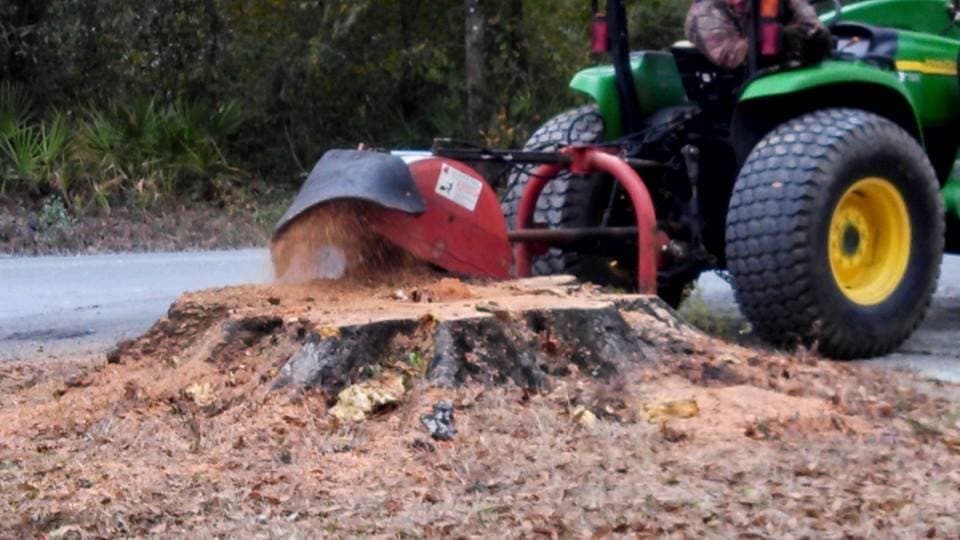
A stump grinder is a piece of equipment with a heavy spinning steel wheel covered in carbide teeth. The operator swings it side-to-side across the stump, taking off an inch or two at a time, until the stump is below grade. The result is a pile of wood chips and a small depression in the ground where the stump used to be.
From there:
- The chips can be hauled away, or left as backfill for the hole.
- The depression gets backfilled with topsoil.
- You can plant grass, lay sod, or build over the spot.
The roots stay in the ground. They'll decompose naturally over the next 5–10 years, breaking down into the soil without doing any harm. For 95% of residential properties, that's exactly what you want.
Stump removal, in one minute
Stump removal means physically extracting the entire root structure — the stump, the main lateral roots, and as much of the root flare as possible. It typically requires either a tracked mini-excavator or a stump-pulling attachment, and it leaves a much larger hole than grinding does.
The hole that's left from full removal is usually 4–8 feet across and 2–4 feet deep, depending on the tree. That hole has to be backfilled with clean fill dirt and topsoil — which is its own line item.
Cost comparison: grinding vs removal
For a typical residential stump in coastal Georgia, expect to pay:
- Stump grinding: $100 – $400 per stump, depending on diameter, root flare, and access. Most residential stumps land in the $150–$250 range.
- Full stump removal: $400 – $1,500+ per stump. Usually 2–4× the cost of grinding because of the heavier equipment, larger hole, and fill dirt required.
For most yards, that's a meaningful difference. Three medium stumps ground out: $450–$750. The same three fully removed: $1,200–$3,000+. That's real money for what amounts to a slightly cleaner hole.
Want more pricing context? Our tree removal cost guide breaks down the broader pricing picture across Effingham, Savannah, and Bryan County.
When stump grinding is the right call (usually)
Grinding is the answer for most situations:
- You want to re-sod or replant grass. Grind 6–10 inches below grade, backfill with topsoil, and you can sod over it. Done.
- You want the eyesore gone. Once the stump is below grade and the depression is filled, you can't tell it was there.
- You want to plant a new tree nearby. Grinding doesn't fully clear the underground roots, but it gets the stump out of the way. The new tree won't care about decaying roots a few feet away.
- You're planning a patio or walkway over the spot. Concrete pours fine over a ground stump as long as it's deep enough — typically 10 inches below the final grade is plenty for a residential slab.
- You're on a budget. Grinding is genuinely half (or less) the cost of full removal. That money is better spent on landscaping the spot afterward.
When full stump removal is worth it
Removal makes sense in a smaller set of cases:
- You're putting in a structural footing. A load-bearing concrete footing for a deck, addition, or pool needs undisturbed soil — not the gradual sink of decomposing roots. In this case, full removal pays off.
- The tree had a major root disease. Some pathogens (like oak wilt or honey fungus) can persist in residual roots and infect new trees planted nearby. If your arborist diagnoses a root disease, full removal can be worth the cost.
- The stump is in a very tight space. Occasionally a stump is so wedged between hardscape (concrete walls, foundations, utility lines) that grinding it cleanly isn't practical.
- You're grading the entire area. If you're re-grading a yard significantly, full removal can be simpler than grinding plus matching the new grade.
What about "chemical stump removal"?
You'll see products at the hardware store — potassium nitrate crystals — marketed as "stump killer" or "stump remover." Honest take: they're slow and partial. They can help dry out the stump over months so it eventually burns or breaks apart easier. They do not remove the stump. If you have time and don't mind the stump sitting there for a year while it slowly rots, they're an option. For everyone else, grinding is faster and cheaper.
Burning or pulling the stump yourself
We get asked. Two cautions:
- Burning: Check your local burn ordinances first. Effingham, Chatham, and Bryan County all have burn rules, and burning a stump is not the same as a brush pile in terms of permits. Beyond the regulation, hardwood stumps smolder for days and rarely burn fully — you end up with a partially charred stump and a fire-risk yard.
- Pulling with a truck: Internet videos make this look easy. Reality: most stumps are anchored by lateral roots that run 6–8 feet out. A truck pulling on the stump usually breaks the truck frame or the chain before it breaks the roots. We do not recommend this.
How we approach stump grinding
Our typical residential stump grind:
- Walk the property. Check for underground utilities, irrigation lines, sprinkler heads, low-voltage lighting. Mark anything we need to avoid.
- Grind 8–10 inches below grade. Deep enough to plant grass, lay sod, or pour concrete over. Deeper than the standard 6 inches some operators settle for.
- Sweep the chips. Either hauled away or used as backfill, depending on your preference. We bring topsoil to top off the depression if you want a finished grade ready to seed.
- Clean up. Yard ready to walk on before we leave.
Quick recap
- Stump grinding: chews the stump to chips, 6–10 inches below grade. $100–$400 per stump. Right answer for 95% of homeowners.
- Stump removal: digs the entire stump and root system out. $400–$1,500+ per stump. Only worth it for structural footings, root disease, or tight hardscape.
- Roots left underground after grinding decompose naturally and don't cause problems for landscaping or new trees nearby.
- Skip chemical "stump removers" for any real timeline; skip burning unless you're cleared for it.
Got a stump (or three)? See our stump-grinding service or call Steve at 912-631-3987 for a free same-day quote.
Need a hand?
Free estimate — same day.
45 years of saw work across Effingham, Savannah, and Bryan County. Call Steve directly, or send a quick form and we'll get back today.
Keep reading
Hurricane Tree Prep for Coastal Georgia: Before, During & After the Storm
Hurricane season tree prep, what to do when a tree falls on your house, and how to find a tree service that won't ghost you mid-job. Specific guidance for Effingham, Savannah, and Bryan County homeowners.
How to Tell If a Tree Is Dangerous: A Coastal Georgia Homeowner's Guide
The honest signs that a tree on your property could come down — what to look for, what to do about it, and when to call a professional. From 45 years of reading trees across Effingham, Savannah, and Bryan County.
Tree Removal Cost in Savannah, Effingham & Bryan County — 2026 Homeowner's Guide
How much does it actually cost to take a tree down in coastal Georgia? What drives the price up, what brings it down, and the typical price ranges for the most common Savannah-area tree removals — from a 45-year saw operation.