Services/Tree Trimming & Removal
01Service
Tree Trimming & Removal
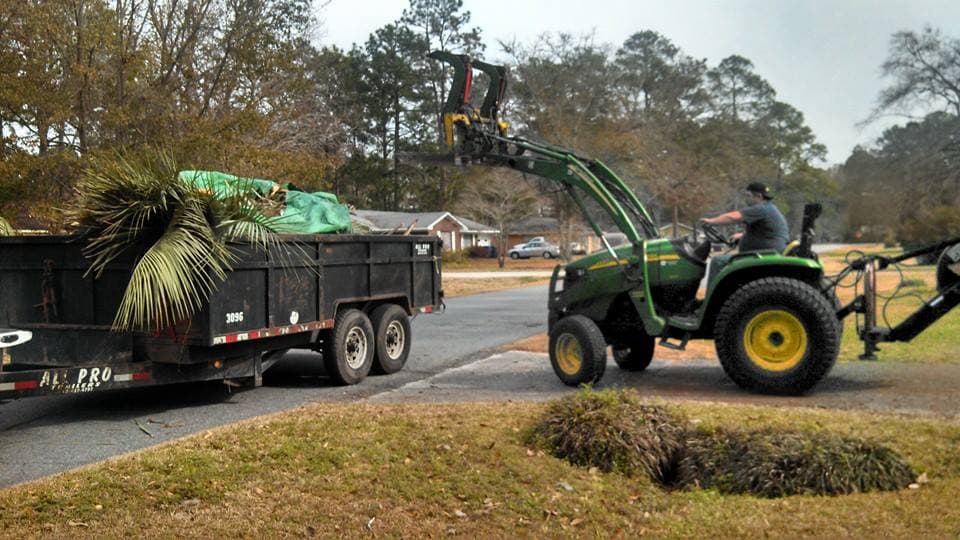
Full-service tree pruning, limb removal, and complete take-downs for residential and small commercial properties.
From a single overhanging limb to a complete take-down, we handle trees of every size with proper rigging, drop zones, and clean-up. Our crew has decades of experience working around houses, sheds, fences, and power lines — and we leave your yard cleaner than we found it.
What's included
- Selective pruning and crown reduction
- Storm damage and emergency removals
- Hazardous lean and dead-tree removal
- Hauling and debris clean-up included
Where we do this work
Tree Trimming & Removal available across Effingham County (Guyton, Rincon, Springfield), the Savannah metro (Savannah, Pooler, Port Wentworth, Garden City, Bloomingdale, Tybee Island, Wilmington Island), and Bryan County (Richmond Hill, Pembroke, Ellabell).
Every tree we touch gets the same first question: does it stay or does it go? A healthy live oak with one storm-cracked limb is a pruning job — a hollow, leaning water oak over your roof is a removal. We walk the tree with you, read the trunk, the lean, the root plate, and what sits under it, and give you a straight answer before a saw ever starts. Forty-five years of coastal-Georgia saw work is mostly knowing which trees are lying to you.
When a tree needs to come out, we take it out in a controlled way — sectional dismantling and rope rigging near a house, sheds, fences, or Georgia Power lines, or a clean directional fell only when there is a true open drop zone. When a tree just needs relief, we prune to industry-standard practice: cuts made just outside the branch collar, no flush cuts, no topping, no lion-tailing, and no more than about a quarter of the live canopy removed in a season. Both jobs end the same way — chipped, raked, and hauled, yard cleaner than we found it.
How the job runs
Our process, step by step.
- 01
On-site assessment
We look at species, height, trunk diameter, lean, canopy health, decay, and — most important — the targets underneath: house, garage, fence, septic field, power line, neighbor. That read decides fell vs. rig, and it is where the free estimate comes from.
- 02
Plan the drop zone & rigging
Open yard means a directional fell with proper face and back cuts. Tight to a structure means we climb or bucket up and take it down in pieces, lowering each limb on ropes and blocks so nothing swings into the house or the fence line.
- 03
Clear & protect the work area
We move vehicles, patio furniture, and anything fragile, set drop pads on delicate turf where it helps, and keep people and pets out of the fall path with a spotter watching the whole time.
- 04
Take it down in sections
Limbs first, then the trunk in manageable lengths. Near power lines we coordinate clearance rather than gamble — a live line is not a place to improvise.
- 05
Chip, cut & stack
Brush goes through the chipper; trunk wood is cut to length. If you want the wood for a fireplace or fire pit, tell us and we stack it — otherwise it leaves with us.
- 06
Stump & full cleanup
We grind the stump if you added that to the job, then rake the area, blow the drive and walks clean, and haul every bit of debris off-site. The only sign we were there is the missing tree.
Coastal Georgia specifics
What this work looks like here.
The trees we cut most
Live oak, water oak, laurel oak, sweetgum, pecan, southern magnolia, crepe myrtle, and the southern pines — loblolly, slash, and longleaf. Water oaks and laurel oaks are the ones that surprise homeowners: they grow fast, hollow out early, and are the trees we most often remove after a storm proves them rotten inside.
Sandy soil & a high water table
Coastal Effingham, Chatham, and Bryan County sit on sandy loam over a high water table. After a wet stretch, that soil lets go of a root plate far more easily than red clay inland — which is why a big pine that looked fine can uproot whole in a tropical storm. We factor saturated-soil root failure into every hazard call.
Hurricane season loading
From June through November, wind loading is the real enemy. Trees carrying Spanish moss, resurrection fern, dead limbs, or a heavy one-sided canopy catch far more wind. Thinning deadwood and reducing end-weight before the season is cheaper than a crane after it.
Permits & protected trees
Rules differ by jurisdiction. The City of Savannah and some local governments regulate protected and heritage trees — live oaks especially — and may require a permit before removal. Outside city limits in unincorporated Effingham or Bryan County, most residential removals are unrestricted. We will flag when we think a tree may be protected so you can check with your local authority before we cut. We do not make that call for you — but we will not blindside you either.
How we keep it safe
Insured, rigged, and careful.
- Fully insured — general liability plus workers' comp — and a certificate of insurance is available on request before we start.
- Rope-and-block rigging with controlled lowering whenever a tree is over a structure, fence, or line — pieces come down on our terms, not gravity's.
- We coordinate with the utility for line clearance near energized Georgia Power conductors instead of working hot lines ourselves.
- Proper pruning cuts at the branch collar, no flush cuts, no topping, no lion-tailing, and the ~25% max-live-canopy rule per season so the tree survives the trim.
- Full PPE on the crew — chaps, helmets, eye and hearing protection — plus a ground spotter keeping the fall path and the public clear for the whole cut.
What moves the price
Honest pricing factors.
- Height & trunk diameter
- A 30-foot crepe myrtle and an 80-foot loblolly are different days of work. Height and trunk diameter are the biggest single driver of the price.
- Proximity to targets
- A tree in an open field can be felled in one drop. The same tree three feet off your roof has to be climbed and rigged down piece by piece — more time, more skill, higher cost.
- Species & wood density
- Dense hardwoods like live oak are slower and heavier to cut and haul than soft, straight pine of the same height.
- Equipment access
- A front-yard tree the chipper can reach is cheaper than a backyard tree we have to carry out through a gate, or one that needs a crane.
- Condition
- Dead, hollow, or storm-damaged trees are less predictable and demand extra rigging and care — that shows up in the quote.
- Stump grinding & debris
- Stump grinding and heavy debris haul are priced on top of the takedown; bundling them into one visit is usually cheaper than separate trips.
Common questions
Tree Trimming & Removal FAQs.
Do I need a permit to remove a tree near Savannah or in Effingham County?
It depends on where you are. The City of Savannah and some local governments regulate protected and heritage trees — particularly live oaks — and may require a permit before removal. In unincorporated Effingham and Bryan County, most residential removals are not restricted. If we think your tree may be protected, we will tell you so you can check with your local authority first.
When is the best time of year to trim my trees?
For most coastal-Georgia hardwoods, late winter dormancy is ideal — the tree is not actively growing and structure is easy to read. That said, dead, hazardous, and storm-damaged limbs should come off whenever you spot them, and thinning before hurricane season reduces wind load when it matters most.
Can you take down a tree that is close to power lines?
Yes. For trees near energized lines we coordinate clearance with the utility rather than working live conductors ourselves, and we rig the tree down in controlled sections. Safety around power is not the place to cut corners.
Will you grind the stump too?
We can. Stump grinding is a separate service, but bundling it into the same visit as the removal is almost always cheaper than a second trip. Just tell us up front and we will quote the whole job together.
How fast can you respond after a storm?
Storm-damaged and hazardous trees get priority scheduling, and repeat and commercial clients get first call. If a limb is on your house or blocking your drive, call us at 912-631-3987 and we will get to you as fast as we safely can.
Are you insured?
Yes — general liability and workers' comp — and we will provide a certificate of insurance before the job starts. On tree work, hiring an uninsured crew means their injury or damage can become your liability, so it is worth confirming.
Other services
Stump Removal
Stump grinding that takes the eyesore below grade so you can plant grass, lay so…
Learn moreShrub & Land Clearing
Overgrown hedges, foundation shrubs, brush, and small-tree thickets cleared down…
Learn moreConcrete Install
Poured concrete patios, walkways, sidewalks, and step installs across Effingham,…
Learn moreCommercial
Tree maintenance, removals, and lot clearing for HOAs, property managers, and co…
Learn more
Ready when you are
A tree you'd rather not deal with?
Free, no-pressure estimates anywhere in Effingham County and the Savannah metro. Same-day response on emergencies.